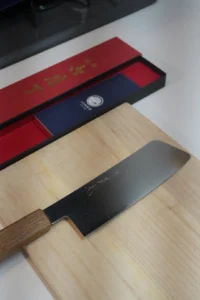
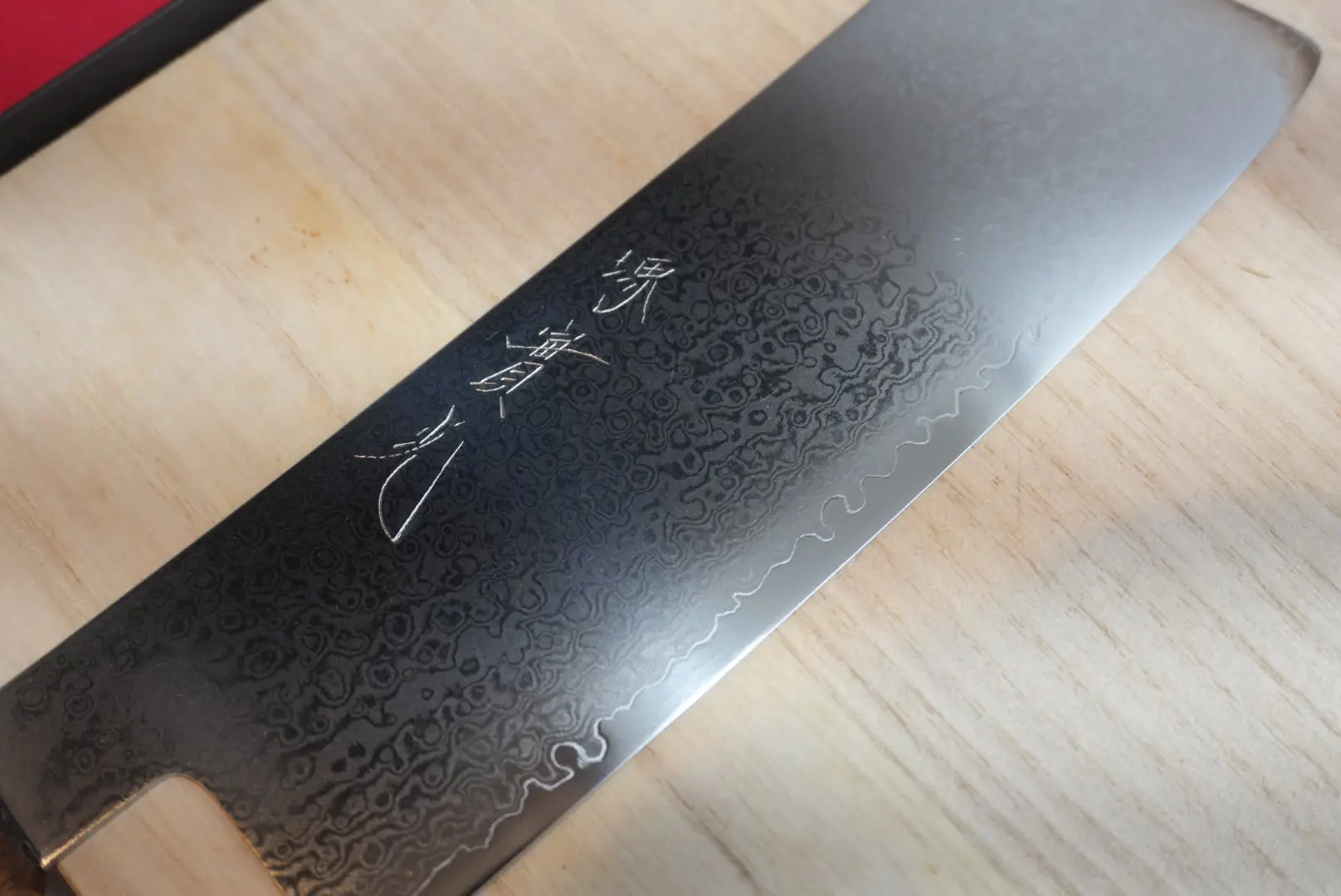
The nakiri is the right choice for almost every home cook. Both are Japanese vegetable knives with rectangular blades, but the nakiri (菜切り) has a double-bevel edge that’s easy to use and maintain, while the usuba (薄刃) has a single-bevel edge built for professional precision — thinner cuts, but a steeper learning curve, harder sharpening, and a higher price.
Rule of thumb: cooking dinner → nakiri. Training in Japanese cuisine or doing katsuramuki → usuba.
Usuba vs Nakiri: Comparison Table
| Feature | Nakiri (菜切り) | Usuba (薄刃) |
|---|---|---|
| Edge type | Double bevel (sharpened both sides) | Single bevel (sharpened one side) |
| Main user | Home cooks | Professional Japanese chefs |
| Skill level | Beginner–Advanced | Advanced / Professional |
| Typical length | 165–180mm | 180–240mm |
| Steel | Usually stainless (VG-10, AUS-8) | Often carbon (White #2 / Blue steel) |
| Sharpening | Standard whetstone routine | Single-bevel + uraoshi (back-side) technique |
| Katsuramuki (rotary peeling) | Possible but limited | Designed for it |
| Left-handed use | Works as-is | Requires a dedicated left-handed blade (extra cost) |
| Price range | $60–$300+ | $80–$500+ |
What Is a Nakiri Knife?
The nakiri (菜切り, “vegetable cutter”) is Japan’s standard home-kitchen vegetable knife. Its rectangular, flat-edged blade lands flush on the cutting board from heel to tip, so every push-cut goes clean through — no compression, no accordion-cut onions. Because the edge is a symmetrical double bevel, it cuts straight, sharpens like any other double-bevel knife, and works for both right- and left-handed cooks out of the box.
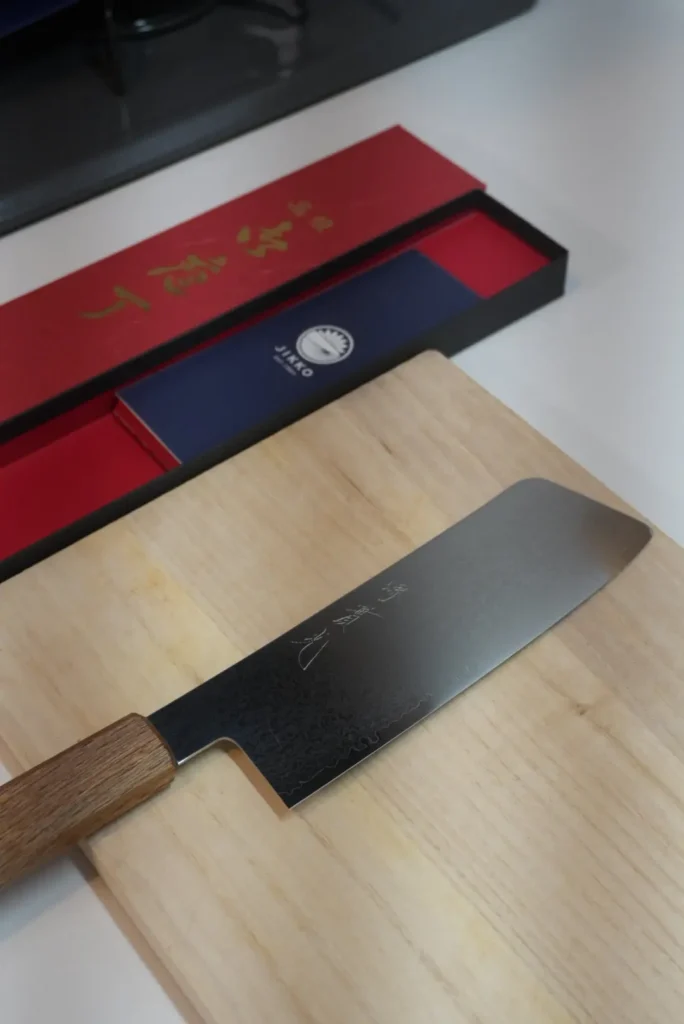
If you’re new to the nakiri, start with our complete guide: Best Nakiri Knife 2026: Japanese Vegetable Knife Guide & Top 5 Picks.
What Is an Usuba Knife?
The usuba (薄刃包丁, “thin blade”) is the professional counterpart — the vegetable knife used in traditional Japanese restaurant kitchens. It looks similar to a nakiri from a distance, but the edge is a single bevel: ground on one side only, with a slightly concave back (urasuki). This geometry produces astonishingly thin, clean slices and enables katsuramuki — the technique of peeling a daikon into one continuous paper-thin sheet, a rite of passage for every washoku chef in training.
There are two regional styles: the square-tipped Edo usuba (Kanto/Tokyo style) and the rounded-spine kamagata usuba (Kansai/Osaka style). Functionally they cut the same; the kamagata’s rounded tip adds a bit of finesse for decorative work (mukimono).
Nakiri vs Usuba: 5 Key Differences
1. Edge Geometry: Double Bevel vs Single Bevel
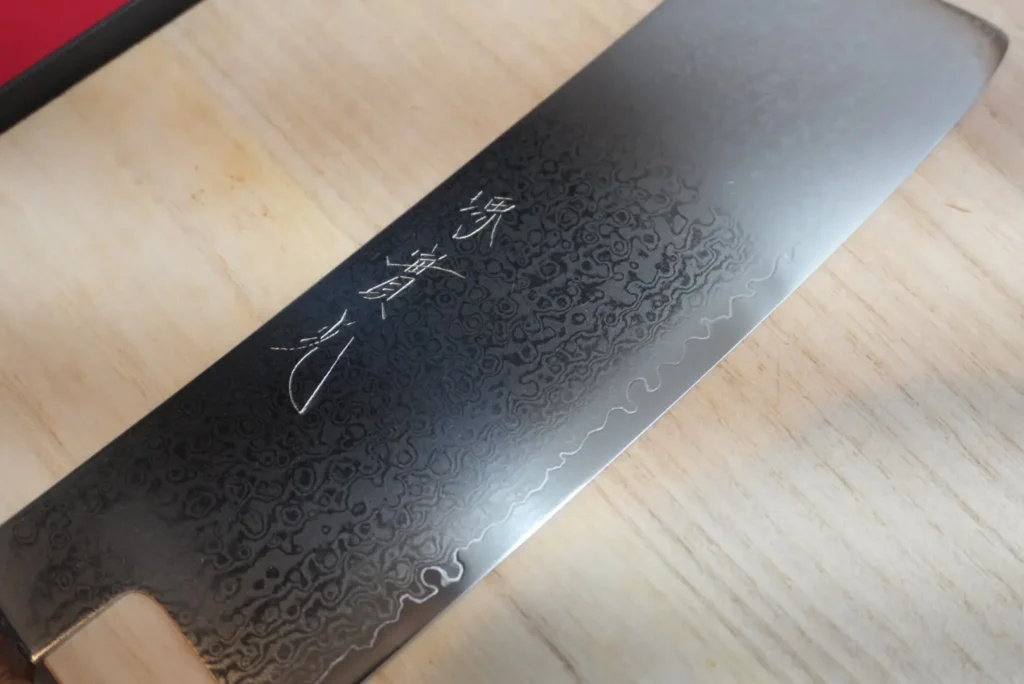
This is the difference that drives everything else. The nakiri’s double bevel tracks straight through the cut and forgives imperfect technique. The usuba’s single bevel takes a thinner, cleaner slice — visibly better for sashimi garnish and decorative cuts — but the blade naturally steers toward the flat side, so it takes practice to cut straight.
2. Learning Curve
You can cook well with a nakiri on day one. The usuba punishes beginners: cuts wander, edges chip if you twist, and katsuramuki takes months of practice. In Japanese culinary schools, the usuba is introduced only after knife fundamentals are solid.
3. Sharpening & Maintenance
A nakiri sharpens like any double-bevel knife: equal strokes each side at 15–17°. A single-bevel usuba needs a different routine — the front bevel is sharpened at a steeper angle, then the flat back gets light “uraoshi” passes to remove the burr without destroying the concave back. Most usuba are also carbon steel (White #2), which takes a wicked edge but rusts if you leave it wet. Budget real time for maintenance.
4. Handedness
A nakiri works for everyone. A standard usuba is ground for right-handed use; left-handed cooks need a dedicated left-handed blade, usually special-ordered at a 30–50% premium.
5. Price
Entry-level Japanese-made nakiri start around $60–$100 (see the Tojiro DP at ~$99). Usuba span a wider range: a genuine Sakai-forged kasumi usuba starts around $140, while a hongasumi-grade professional usuba from a house like Masamoto runs $390 and up. You’re paying for single-bevel grinding skill, which only experienced smiths do well — and for the hand-finishing (honbazuke) that a single bevel demands.
Which Should You Buy?
- Buy a nakiri if: you cook at home, you want cleaner vegetable prep without changing your technique, or this is your first Japanese knife. This is the right answer for ~95% of readers.
- Buy an usuba if: you’re training in Japanese cuisine, you want to learn katsuramuki and mukimono, or you already own a nakiri and want the professional ceiling.
- Own both? That’s how Japanese professional kitchens do it — nakiri (or gyuto) for volume prep, usuba for precision work. But nobody starts with the usuba.
Our Recommendations
Best Nakiri to Start With
Our full rankings live in the Best Nakiri Knife guide — the short version: JIKKO Damascus (hands-on review) if you want Sakai-made artisan quality, Tojiro DP (~$99) if you want the most affordable genuinely Japanese blade.
Where to Buy an Usuba
Usuba stock rotates constantly because most are hand-forged in small batches, so buy from a US-based stockist rather than waiting on an import. Two lines worth knowing:
- Sakai Takayuki Kasumitogi Kamagata Usuba (180 / 195 / 210mm) — the Kansai rounded-spine style, forged in Sakai. The classic first usuba.
- Masamoto KS Hongasumi Usuba (180 / 210mm) — Tokyo’s Masamoto, white carbon steel, hongasumi construction. A professional’s usuba.
Chubo Knives (NYC-based, ships from US stock) carries both lines in its Japanese vegetable knife range. Prices below are what we verified at the time of writing — worth checking both sources, because the same Masamoto typically lists higher on Amazon, where it is sold by third-party importers rather than by a knife specialist.
| Usuba | Tier | Chubo | Amazon |
|---|---|---|---|
| Sakai Takayuki Kasumitogi Kamagata 180mm | First usuba | $142 | — |
| Masamoto KS Hongasumi 180mm | Professional | $390 | ~$445 |
If you want the Masamoto shipped on Prime today, it is on Amazon — just expect to pay the convenience premium:
For the better price on the same knife — or for the $142 Sakai Takayuki if this is your first usuba — browse Chubo’s range:
Buy from a US Knife Specialist
Single-bevel knives are the hardest category to buy sight-unseen, and most general retailers barely stock them. Bernal Cutlery keeps a dedicated single-bevel range — usuba included — and, unusually for a US shop, they can sharpen a single bevel properly if you ever need it done.
Frequently Asked Questions
Is an usuba harder to use than a nakiri?
Yes. The usuba’s single-bevel edge steers toward its flat side, so cutting straight takes deliberate practice. The nakiri’s double bevel tracks straight naturally, which is why it’s the standard recommendation for home cooks.
Can you use an usuba for meat or fish?
No — the usuba is a dedicated vegetable knife. Its thin single-bevel edge chips easily against bone, sinew, or frozen food. Japanese kitchens pair it with a deba (fish) and gyuto or sujihiki (meat).
What is katsuramuki?
Katsuramuki (桂剥き) is the Japanese technique of rotating a cylinder of daikon (or cucumber) against the blade to peel one continuous, paper-thin sheet. It’s the signature skill the usuba was designed for, and a standard training benchmark for washoku chefs.
Do left-handed cooks need a special usuba?
Yes. A standard usuba is ground for right-handed use. Left-handed versions are mirror-ground and typically cost 30–50% more, often as a special order. A nakiri, being double-bevel, works for either hand.
Is the usuba sharper than the nakiri?
At the edge, a well-maintained usuba takes a finer cutting angle than a double-bevel nakiri, so it produces thinner, cleaner slices. But “sharper” only pays off with correct technique — in untrained hands a good nakiri cuts better in practice.
Verdict: Nakiri for the Kitchen, Usuba for the Craft
The comparison isn’t really “which is better” — it’s “which job are you hiring for.” The nakiri is the practical Japanese vegetable knife: forgiving, low-maintenance, immediately better than a Western chef knife for produce. The usuba is a professional instrument that rewards years of technique with cuts a nakiri can’t match. Start with the nakiri; graduate to the usuba when the craft calls you.
This article contains affiliate links. If you purchase through our links, we may earn a small commission at no extra cost to you.