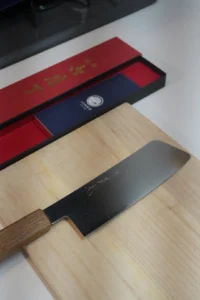
Nakiri is a dedicated vegetable knife — flat blade, push-cut only, no tip. Santoku is a versatile all-rounder that handles vegetables, fish, and meat. If vegetables dominate your cooking, get the nakiri. If you want one Japanese knife that does everything, get the santoku.
The Core Difference
Both knives are Japanese, both are typically 165–180mm, and both are exceptional at cutting vegetables. The difference is purpose: the nakiri was built exclusively for vegetables, while the santoku was designed to do a little of everything.
That single difference changes the blade shape, the cutting motion, and who each knife is right for.
Blade Design: What Makes Each Unique
| Nakiri | Santoku | |
|---|---|---|
| Blade shape | Rectangular, fully flat edge | Curved belly with short tip |
| Tip | None (blunt square end) | Present (sheep’s foot / drop point) |
| Typical length | 165–180mm | 165–180mm |
| Cutting motion | Push-cut only (up-and-down) | Push-cut + light rocking |
| Best for | Vegetables | Vegetables, fish, meat |
| Versatility | Low (specialist) | High (generalist) |
| Typical steel | High-carbon / stainless | High-carbon / stainless |
| Price range | $80–$300 | $80–$350 |
The nakiri’s flat edge makes full contact with the cutting board on every stroke — no heel gap, no uncut bits. The santoku’s curved belly allows a rocking motion that makes it faster and more adaptable across different ingredients.
Performance Head-to-Head
Vegetables
This is where the nakiri wins, and it’s not close. The flat blade glides through cabbage, onions, and carrots with almost no resistance. Push-cutting produces cleaner, more consistent slices because the blade doesn’t push food sideways the way a curved edge does.
The santoku is genuinely excellent at vegetables too — better than any German knife — but the nakiri has a decisive edge (literally) for anyone who does heavy vegetable prep.
Meat & Fish
The santoku handles boneless proteins cleanly. Its tip gives you a starting point for precise cuts, and the curved belly lets you slice through chicken breast or fish fillets with a smooth rocking draw.
The nakiri’s blunt square tip makes meat work awkward. You can cut boneless meat with it, but it’s not designed for it. Neither knife should touch bones — that’s a job for a deba or a Western cleaver.
Everyday Versatility
If you cook a variety of meals — vegetables one night, chicken the next, fish on weekends — the santoku is the knife you’ll reach for every time. It’s Japan’s most popular home kitchen knife for exactly this reason.
The nakiri earns its place when vegetables are genuinely central to how you cook — not as a side dish, but as the main event.
Who Should Choose the Nakiri?
- Plant-forward cooks — vegetarian, vegan, or anyone whose meals are built around produce
- Asian cuisine enthusiasts — where precise vegetable cuts matter (stir-fry, ramen, sushi prep)
- Already-own a chef’s knife — the nakiri complements your existing kit as a specialist tool
- Gift buyers — the nakiri’s distinctive shape and beautiful aesthetics make it a memorable gift for serious home cooks
→ See our full Nakiri Knife Guide and JIKKO Nakiri Review for deeper reading.
Who Should Choose the Santoku?
- Home cooks who want one great Japanese knife — the santoku does it all
- Cooks who regularly handle fish or boneless meat — the santoku’s tip makes these tasks much easier
- Knife beginners — the rocking motion is familiar to anyone coming from a Western chef’s knife
- Budget-conscious buyers — excellent santoku knives are available at every price point
→ See our full Santoku Knife Guide for detailed recommendations.
Can You Own Both?
Absolutely — and many serious home cooks do. The nakiri and santoku are genuinely complementary: one dominates vegetable prep, the other handles everything else. If your budget allows two knives, this pairing covers the full range of a Japanese home kitchen with no overlap and no gaps.
My Top Picks
Best Nakiri Knives
#1 — JIKKO Damascus Nakiri (Editor’s Pick)
- Price: From $180
- Steel: High-carbon, HRC 60–63
- Origin: Sakai, Osaka — 120 years of craft heritage
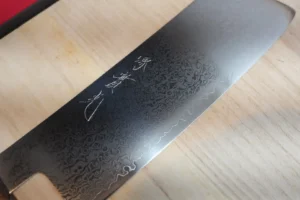
- Why I recommend it: This is the nakiri I use daily. The flat blade glides through vegetables with almost zero pressure. Exceptional build quality and stunning hand-engraved Damascus finish.
#2 — Tojiro Damascus Nakiri
- Price: From $149.99
- Steel: VG-10 Damascus, 37-layer
- Blade Length: 7 inches (180mm)
- Handle: Micarta with 3 stainless steel rivets
- Made in Japan
- Why I recommend it: A serious Damascus nakiri at a fair price. The 37-layer VG-10 core holds an exceptional edge, and the bolster keeps the blade steady through straight vegetable cuts. The Micarta handle is comfortable and built to last.
Best Santoku Knives
#1 — Global G-48 Santoku (Overall Pick)
- Price: From $149
- Steel: CROMOVA 18 (molybdenum/vanadium stainless), Hollow Ground
- Blade Length: 7 inches (18cm)
- Handle: Stainless steel, dimpled for safe grip
- Why I recommend it: An all-purpose hollow-ground santoku for chopping, dicing, and slicing. Face-ground with a long taper so the edge stays sharp longer. Global’s iconic dimpled all-steel handle is molded for comfort and one of the most recognisable in any kitchen. Wash by hand; lifetime quality.
#2 — Tojiro Professional Santoku (Best Value)
- Price: From $109
- Blade Length: 6.7 inches (17cm)
- Steel: Cobalt alloy steel core, 13-chrome stainless, 18-8 stainless base
- Handle: Black laminated reinforced wood (ECO wood)
- Made in Japan — double-bevel, suits both left and right-handed users
- Why I recommend it: A professional-grade santoku at a genuinely honest price. The cobalt alloy core delivers stain-resistant sharpness that holds up through daily use. Amazon’s Choice for good reason — consistent quality, reliable edge, and one of the best value Japanese knives available overseas.
Frequently Asked Questions
- Is a nakiri knife better than a santoku?
-
For vegetables specifically, yes — the nakiri’s flat blade makes full contact with the board on every stroke, producing cleaner cuts with less effort. But the santoku is far more versatile and handles meat and fish too. “Better” depends entirely on how you cook.
- Can a nakiri knife replace a santoku?
-
Not fully. A nakiri’s blunt tip and push-cut-only design make it awkward for meat, fish, and detailed knife work. If you cook a variety of proteins alongside vegetables, you need the santoku’s versatility. The nakiri excels as a specialist, not a replacement for a general-purpose knife.
- What is the nakiri knife best used for?
-
The nakiri knife is purpose-built for vegetables. Its flat blade and push-cut motion produce clean, consistent slices through cabbage, carrots, onions, cucumber, and herbs. It is especially effective for Asian-style vegetable prep where precision matters.
- Is nakiri vs santoku a common dilemma for beginners?
-
Very common — both are Japanese knives of similar size and price, so the choice isn’t obvious at first. Our recommendation: if this is your first Japanese knife, start with the santoku. Add the nakiri later if vegetable prep becomes a priority in your cooking.
- Which is easier to sharpen, nakiri or santoku?
-
The nakiri is marginally easier to sharpen on a whetstone because its flat blade sits consistently against the stone with no need to adjust for a curved belly. Both are double-bevel (50/50), so the sharpening angle and technique are the same.
Verdict
Choose the nakiri if vegetables are the heart of your cooking and you want a knife that does one thing exceptionally well.
Choose the santoku if you want a single Japanese knife that handles everything — the most versatile, practical choice for most home kitchens.
Either way, you’re choosing a Japanese blade that will outperform most Western knives at a comparable price. The real question isn’t nakiri or santoku — it’s which one you need first.
— Takuma, Tsuru Knife
Disclosure: Some links are affiliate links. If you purchase through them, we earn a small commission at no extra cost to you. We only recommend products we have personally tested or thoroughly researched.